When advertising gets more expensive, it pays more for each customer to buy a little more. Three ways and one important metric.
Advertising gets more expensive every year, and every first sale costs more and more. At the eCommerce Annual Summit 2026, Aleksandar Ivanov (CreateX) showed the simple calculation: sometimes it pays more to increase the value of each order than to buy more customers.
First: look at the till, not the platform
Every advertising platform claims the sale for itself. A customer sees an ad on Facebook, searches for the brand in Google and buys from an email. The three channels report the same order three times.
That’s why you should look at the overall result: total revenue divided by total marketing spend. In the example from the talk, the channels report a total of €65,000 in sales, while €45,000 actually comes into the till. Meta’s report shows a return of 4.0, while the real one is 2.25.
How to calculate it every month
- Take the shop’s real revenue for the month, from the till or from the order system.
- Add up all marketing costs: ads on all platforms, the email tool, agencies, influencers.
- Divide the first by the second.
If the number grows, marketing as a whole is working better, regardless of what each platform shows separately. If it falls, something is wrong, even if all the reports look green.
The average-order calculation
The same €10,000 of advertising, the same 500 orders:
- with an average order of €60, revenue is €30,000;
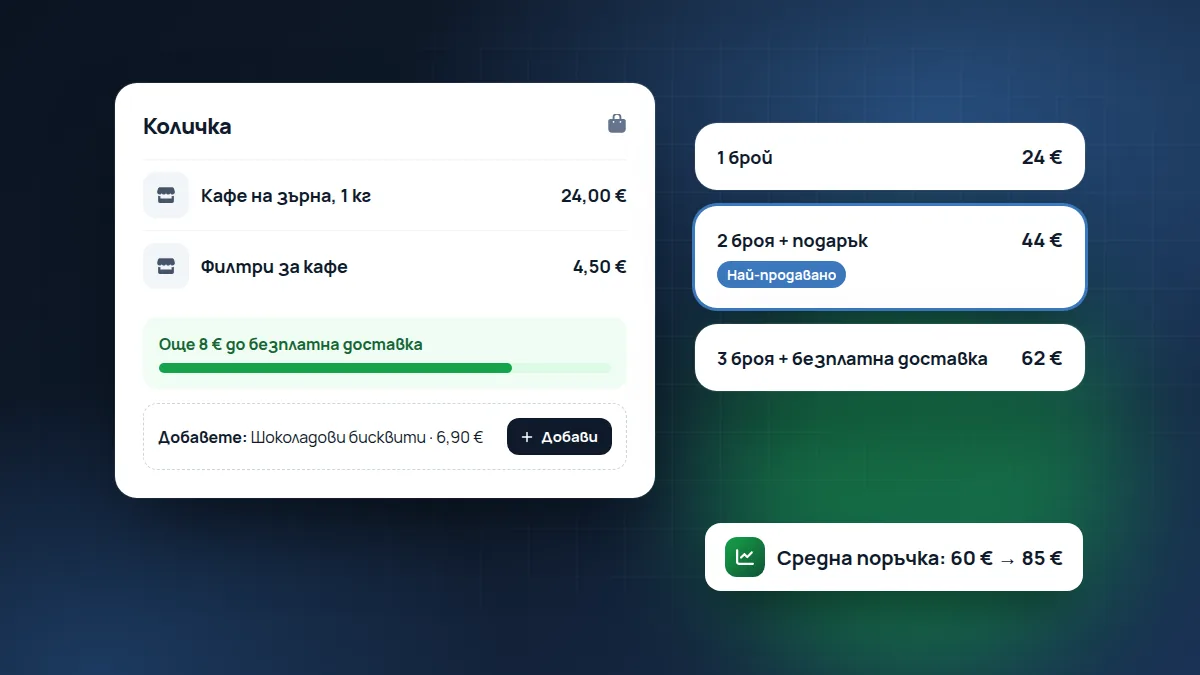
- with an average order of €85, revenue is €42,500.
Or the same €30,000 revenue with about 29% less advertising.
The average order is easy to calculate: revenue for the period divided by the number of orders. Most shop platforms show it directly.
Three ways to do it
1. Three offer tiers on the product page. For example 1 item, 2 items with a gift (marked “best seller”) and 3 items with free delivery. The middle option, marked “best seller”, often wins.
2. A free-delivery progress bar in the basket. “Only €8 more for free delivery” encourages adding something else, especially if there is a suitable small product right below it.
3. An offer in the basket. One or two products that go with the chosen one, with a clear price and an “Add” button.
How to choose the free-delivery threshold
It’s good for the threshold to be a little above your current average order, so that some customers add something else to reach it. If the average order is €40, a threshold of €50 is achievable. A threshold of €100 is too far away and people simply pay for delivery.
What to offer in the basket
- Things that go together: cream and serum, coffee and filters, food and a treat for the dog.
- Small and cheap: the product in the offer should be significantly cheaper than the main one, otherwise the person thinks again.
- Genuinely relevant: offering winter tyres to go with summer rims is irritating. It’s better to have fewer but accurate offers.
Bundles instead of discounts
Instead of “-15% on everything”, think about bundles: “Dry skin set: cleansing gel, cream and serum.” The customer gets a ready-made solution, you sell more products at once, and you don’t teach people to wait for reductions.
Bundles work especially well as gifts, around the holidays.
And if you sell something that runs out?
Coffee, cosmetics, supplements, pet food: here a subscription turns a one-off purchase into a steady income. Boris Bivolarski showed at the same conference that subscriptions work when the customer has full control: easy pausing, changing the product and a reminder 2–3 days before payment. Hidden cancellation is the fastest way to lose trust.
Even if you don’t have a technical subscription, a refill email sent at the moment the product usually runs out achieves part of the same effect.
What not to do
- Push too hard. Three pop-ups with offers before payment annoy people and make them abandon the basket.
- Hide the price of the add-on or add it automatically. That is both illegal and undermines trust.
- Look only at the average order. If it grows but the number of orders falls, you may have overdone it. Look at both together.
Where to start
Look at your average order for the last 3 months and put it next to your advertising spend. Then choose one of the changes above, run it for a month and compare. Don’t change everything at once, otherwise you won’t know what worked.
If you want your website to offer the bigger order by itself, see how we work.
Based on the talks by Aleksandar Ivanov (CreateX) and Boris Bivolarski at the eCommerce Annual Summit 2026.
Found this article useful? Share it.