More cautious shoppers, fewer categories and a lot of price comparison because of the euro. What this means for a small online shop.
At the eCommerce Annual Summit 2026, Market LINKS presented fresh data on how Bulgarians shop online and what attitudes they bring to Black Friday. The picture is clear: people are online more than ever, but they spend more carefully.
What the numbers say
- 91% of adults use the internet, 2 points more than in 2025. The oldest generation is catching up fastest: 79% of people over 62 are now online.
- 54% of internet users have shopped online in the last six months. The share has stayed at similar levels for three years in a row, which means the market isn’t growing by itself.
- Half of households (50%) report a deterioration in their financial situation, compared with 42% in the previous two years.
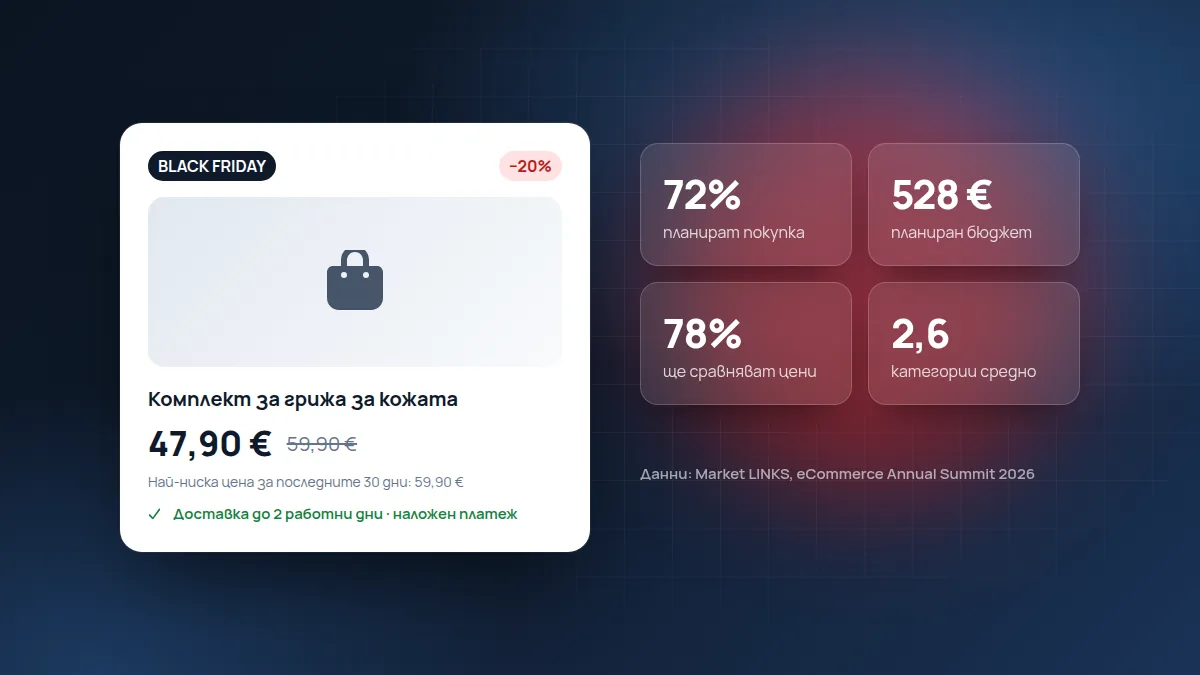
- 72% of online shoppers plan a purchase on Black Friday, compared with 78% last year.
- The planned budget is €528 per person, about 16% less than in 2025. Almost all of the drop comes from people buying in fewer categories (on average 2.6 instead of 2.9), not from lower amounts.
What these numbers mean in practice
The market isn’t growing by itself. When the share of online shoppers stays in one place for three years, every new customer is taken from some other shop. The winner isn’t the one who simply “is online”, but the one where it is easier, clearer and more trustworthy.
Older shoppers are coming. 79% of people over 62 are already online. These are customers who value large type, clear buttons, a phone number to call and cash on delivery. A website that is convenient for them is convenient for everyone.
People aren’t spending less per purchase, they’re buying in fewer categories. This matters: the customer isn’t looking for the cheapest in everything. They choose where to spend, and there they’re ready to pay. If you’re in their 2–3 categories, you need to be the most convincing option in them.
The “euro” effect
About 8 in 10 people who plan to shop on Black Friday say that, because of the euro, they will:
- spend more cautiously (79%);
- compare prices more carefully (78%);
- check whether the discounts are real (78%).
In addition, 63% are open to shopping from stores in other eurozone countries. The competition is no longer just the Bulgarian shop across the street.
What “will check” means
In practice, the customer will open your shop and two or three more in neighbouring tabs. They’ll look at the price, delivery, timeframe and returns policy. They’ll check in Google whether your price was the same a month ago. If in doubt, they’ll close the tab.
The advantage of a Bulgarian shop over foreign ones lies in what they find hard to offer: fast delivery with Econt or Speedy, cash on delivery, service in Bulgarian, easy returns within the country. Show these things clearly, not in the terms and conditions.
What to do as a small business
1. Show that the discount is real. Show the previous price and how much the customer saves, clearly and honestly. People will check, and an “inflated” discount costs trust for years. When you announce a discount in the EU, you also have to state the lowest price of the last 30 days.
2. Prices in euros, no surprises. The final price, delivery and delivery time must be visible on the product page, not only in the basket.
3. Start earlier. TikTok’s data for Europe shows that people start looking for Black Friday offers as early as October. An email list launched now is the cheapest channel in November.
4. Focus on a few strong offers. Shoppers are narrowing their categories. It’s better to have 3–4 really good offers than “everything at -10%”.
5. A fast and clear website on a phone. A large share of Black Friday purchases are made from a phone, often in a hurry. If the page loads slowly or the order form is complicated, the customer simply opens the next shop.
A week-by-week plan
October: preparation
- Choose 3–4 products or packages that will be your main offers.
- Check stock and suppliers’ lead times.
- Add an email field on the website: “Email me when the Black Friday offers start.”
- Run the website through pagespeed.web.dev for mobile and fix the heaviest photos.
Early November: warming up
- Send subscribers a short email about what’s coming and when.
- Prepare an offers page, still hidden or marked “Coming on …”.
- Test the order from a phone from start to finish: basket, delivery, payment, confirmation.
Black Friday week
- Launch the offers at the announced time and send an email to subscribers.
- Keep an eye on stock and remove sold-out products immediately.
- Reply quickly to questions by phone and chat. In this week a slow reply is a lost order.
Afterwards
- Thank customers with an email after delivery and ask them for a review.
- Record which offers worked and which didn’t. This is the most valuable information for next year.
What not to do
- Raise prices in October in order to “reduce” them in November. People check, and the law also requires you to state the lowest price of the last 30 days.
- Promise delivery you can’t fulfil. In the peak week couriers are overloaded. It’s better to honestly say “3–5 working days” than “tomorrow” and then be late.
- Send emails every day to the whole list. A few well-planned emails work better than a stream that makes people unsubscribe right before the holidays.
Not sure whether your website is ready for the busy season? Check it for free in a minute. If you want help with emails to customers before the holidays, see Email marketing.
Source: national surveys by Market LINKS (2024–2026) and TikTok, presented at the eCommerce Annual Summit 2026.
Found this article useful? Share it.